Fixing Uneven Color Patches in Naturally Colored Annatto Soap
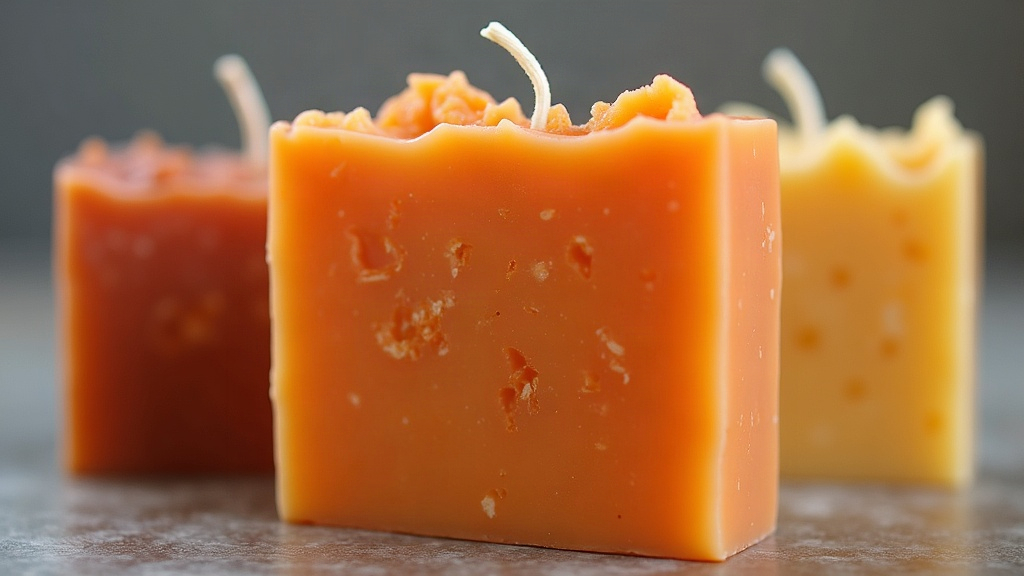
Why Annatto Soap Ends Up Blotchy (And How to Actually Fix It)
Uneven color patches in annatto-colored soap almost always trace back to three things: how the pigment got dispersed before trace, how the batter was mixed, and how fast it moved through the whole soaping process. Here’s the reassuring part. Annatto is one of the more forgiving natural colorants once you get a feel for its quirks, and most blotching problems clear up with a handful of technique tweaks.
Why Annatto Causes Uneven Color in the First Place
Annatto gets its warm orange-yellow hue from bixin, a fat-soluble pigment sitting in the seed coating. Since it’s oil-soluble, not water-soluble, it behaves nothing like clays or oxide powders. That single fact explains most of the blotching you’ll run into:
- It needs oil, not water, to carry it. Toss annatto powder straight into lye water, or dust it onto raw batter, and you’ll get clumps and streaks almost guaranteed.
- It’s heat- and light-sensitive. Push the infusion temperature too high and you can degrade the pigment or concentrate it unevenly in spots.
- It separates if not emulsified properly. Infused oil can settle to the bottom or float on top if it’s stirred into batter that’s too thin, or poured too slowly.
- Trace speed matters. If your soap reaches trace unevenly, which happens a lot with hand-stirring or partial stick blending, the pigment simply doesn’t have time to spread before the batter firms up.
The Fix: Proper Annatto Infusion Technique
Step 1: Infuse Correctly
Use annatto seeds, not powder if you can help it, infused in a liquid oil such as sunflower, sweet almond, or olive oil:
- Heat the oil gently to 150-160°F (65-70°C). Never let it boil.
- Add 1-2 tablespoons of seeds per cup of oil.
- Let it sit, covered and off heat, for several hours or overnight.
- Strain thoroughly through fine mesh or cheesecloth. Leftover seed fragments are probably the single biggest cause of speckling and patchy spots in finished bars.
Step 2: Measure Pigment Strength Before Adding to Batter
Infusion strength swings a lot depending on steep time and seed quality, so don’t just eyeball it. Test a small batch first, or better yet, mix your infused oil into a small portion of your total batter, blend that until it’s fully smooth, then fold the colored portion back into the rest. This “color dispersion” trick is, hands down, the biggest fix for blotchy soap. If you remember nothing else from this article, remember this step.
Step 3: Add at the Right Trace
Add the annatto oil at light trace, not at emulsion and not at thick trace:
- Too early (thin trace or emulsion): the pigment can separate or pool while the soap cures.
- Too late (thick trace): you won’t have enough working time to disperse it fully, and streaks are the result.
Common Causes of Patchy Annatto Soap (and Fixes)
| Problem | Likely Cause | Fix |
|---|---|---|
| Dark orange speckles | Unstrained seed particles | Strain infused oil twice through fine cloth |
| Pale and dark swirling streaks | Poor mixing at trace | Pre-disperse color in a cup of batter before folding in |
| Color concentrated at top/bottom | Added too early, batter too thin | Add at light trace, pour promptly after mixing |
| Faded, blotchy pastel patches | Weak infusion or old annatto seeds | Re-infuse with fresh seeds, increase steep time |
| Orange “volcanoing” in mold | Overheated batter (gel phase irregularities) | Insulate evenly or deliberately force full gel |
Gel Phase Matters More Than You Think
A lot of annatto soap looks patchy right after unmolding for a reason that has nothing to do with the pigment: partial gel phase. When only part of the loaf hits gel temperature, you end up with a visible split between the gelled section (darker, more translucent) and the ungelled section (lighter, more opaque). Picture a loaf that’s rich amber in the center and pale butter-yellow along the edges, that’s gel phase doing its thing unevenly, not a mixing mistake.
To avoid this:
- Insulate the whole mold evenly, with a towel or box covering all sides, not just the top.
- Keep the mold away from drafts or cold surfaces touching one side only.
- For full, even color, force a complete gel with CPOP (cold process oven process): about an hour at a low, steady 170°F (77°C), oven off.
- If pastel, no-gel soap is the look you’re after, chill the entire mold in the fridge, not just part of it.
Can You Fix Already-Made Blotchy Soap?
Once the soap has set, you can’t go back and redistribute color. But you’ve still got options:
- Rebatch it: shred the soap, melt it gently with a splash of liquid, remold. This evens out the hue, though you’ll trade away some shine and get a rougher texture.
- Lean into it. A lot of buyers genuinely like the one-of-a-kind, marbled look; slight color variation reads as “handmade,” not “flawed.”
- Chop it into confetti or use it as embeds in your next batch. That hides the uneven patches completely and gives you a fun visual bonus in a new bar.
Final Thoughts
Uneven color in annatto soap is rarely about the annatto itself. It’s almost always a mixing issue, a trace-timing issue, or a gel phase issue. Strain your infused oil well, pre-disperse the color into a small portion of batter before blending it into the full batch, add it at light trace, and keep your gel phase consistent across the whole mold. Get those four things right and you’ll land a smooth, warm golden-orange bar batch after batch, with a lot less guesswork than you started with.